
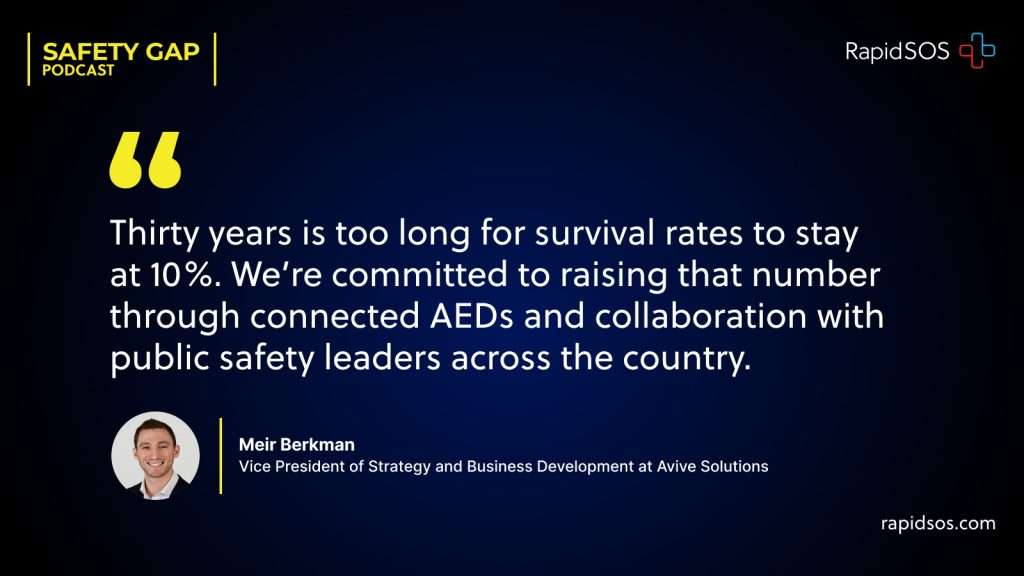
In a cardiac emergency, time is everything. The sooner the individual gets care, the likelier they will be alright. Yet, despite the more widespread availability of automated external defibrillators, or AEDs, the survival rate for sudden cardiac arrest remains at just 10%.
Avive Solutions, Inc. co-founders Rory Beyer, Moseley Andrews, and Sameer Jafri knew there was a way to boost this number. They discovered a few key challenges with existing AED technology: many people don’t know how to work an AED, they could be hard to find in public settings, and often weren’t available in private homes, where the bulk of unexpected cardiac emergencies occur.
Meanwhile, in the rush to help, people are often frantic and unable to provide the information the 911 telecommunicator needs to send help promptly. While the person suffering the cardiac incident may be getting immediate assistance, there’s a safety gap preventing first responders from arriving at the scene and providing the trained medical care the individual really needs.

“What we tend to forget is the AED as a core component of that chain of survival,” Meir Berkman, vice president of strategy at Avive, said on a recent episode of the “Safety Gap’ product. “Historically it hasn’t been connected, and it couldn’t be a part of it, and nobody could see what was going on with it.”
Avive’s portable AED is smaller than traditional AEDs, more user-friendly, and can be stored nearly anywhere. The devices have WiFi, Bluetooth, cellular and GPS technology built in. And through integration with RapidSOS, 911 centers can get real-time alerts when AEDs are in use, along with preliminary data about what’s going on – like how many shocks have been delivered or if it’s an adult or infant.
“The telecommunicator has really strong insights into what’s going on with it, where it is, and when it’s being used and if it’s being used correctly,” Meir said.
Avive also made the machine easier to use. Unlike traditional AEDs, Avive’s machines don’t require users to switch out the electrical pads depending on whether it’s an adult or child. They’re also guided by a more comforting, natural-sounding voice to help give users confidence in their ability to provide help.
Meanwhile, Avive’s system can automatically ping nearby AEDs in an emergency. For example, if someone suffers a cardiac incident in their home, a neighbor with an Avive portable AED can get an alert that help is needed.
Ultimately, this helps Avive achieve its goal of getting AEDs to the scene in under four minutes.
“If we can do faster, then that’s great,” said Meir.

While the first priority in an emergency should always be to call 911, Avive adds an extra layer of safety and security. Not only that, it gives telecommunicators the advanced information they need to coordinate with first responders more seamlessly. And in a cardiac emergency, this efficiency can save lives.
“Telecommunicators are providing absolutely critical instructions over the phone to people who are experiencing the worst emergency that they’ve ever experienced in their entire life,” Meir said. “We shouldn’t understate the absolutely heroic and incredible work that telecommunicators do.”
Be sure to listen to the full episode here.
And be sure to follow us on YouTube, LinkedIn, and Facebook.