
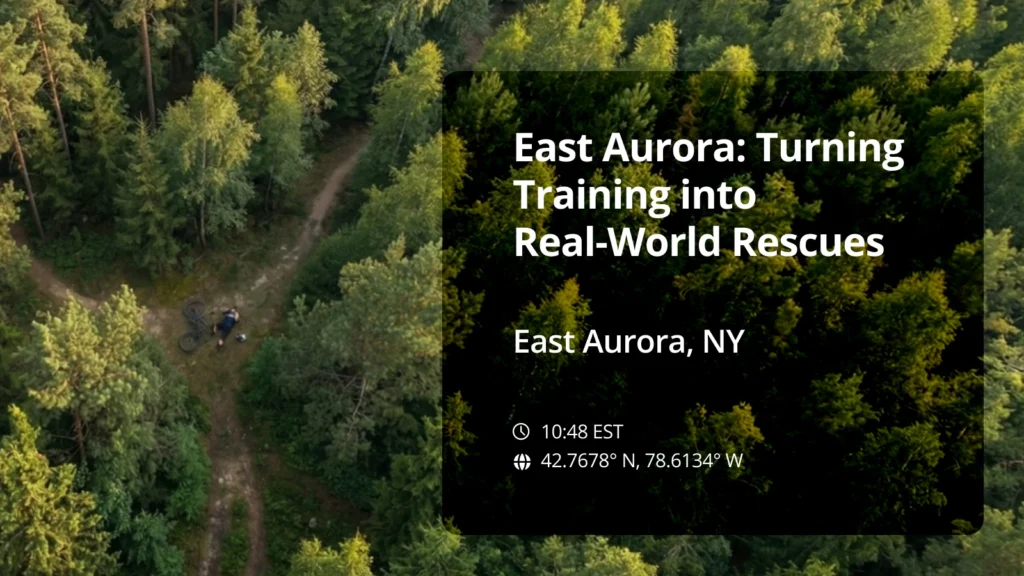

When Training Meets Real-Life
RAPIDSOS UNITE FEATURE
Real-time location tracking, Live Video
In emergency response, location data only changes outcomes when everyone trusts it.
For many agencies adopting RapidSOS through county or regional implementations, that trust doesn’t develop at the same pace everywhere. Dispatchers see the platform daily. Field responders experience it only when incidents demand it. Bridging that gap takes more than rollout emails or policy updates—it takes shared experience.
In East Aurora, New York, that realization led to action.
Communications Supervisor Aaron Denz understands both sides of the radio. Alongside his role in the 911 center, he has served for years in the fire service, including as Chief of the East Aurora Fire Department. That dual perspective made one thing clear: if responders were going to rely on RapidSOS coordinates in critical moments, they needed to experience the workflow firsthand with dispatch—not hear about it secondhand.
So the agencies trained together.
A realistic search-and-rescue drill brought dispatchers and multiple fire companies into the same live process: a real 911 call, real RapidSOS location data, and responders navigating directly to the caller using coordinates provided by the ECC. No scripted staging. No demonstration environment. Just dispatch and field units operating exactly as they would in an actual incident.
The result was immediate. Crews located the caller quickly. Coordinates flowed cleanly from console to responders. The technology became operational—not theoretical.
Then, minutes later, it became lifesaving.
Lost in the Woods — Trust in Action
Shortly after the drill concluded and units returned to quarters, dispatch received an urgent call: two young children were lost in the woods behind their grandparents’ home.
The caller was using an out-of-service cell phone—able to reach 911 but unable to provide reliable legacy location information. Historically, this type of incident would trigger expanding search grids, additional resources, and prolonged uncertainty.
But this time, the workflow was fresh.
Dispatch pushed RapidSOS coordinates directly to responding fire crews—the same process they had just practiced.
Responders moved immediately, approaching from different directions and walking straight to the girls’ location.
Inside the ECC, the confidence in location changed everything. One dispatcher stayed fully engaged with the children, keeping them calm and stationary. Another coordinated responder movement on the live map. Within roughly 30 minutes, both girls were located safely.
For everyone involved, the impact was unmistakable: the same training that built trust minutes earlier now enabled decisive action.

Injured Cyclist — Confidence Under Pressure
Not long after, that alignment proved itself again.
A mountain biker crashed in a heavily wooded park, striking his head and attempting to walk out while injured. As the call was transferred into the ECC, RapidSOS provided continuous location updates showing his movement through the terrain.
With responders already mobilizing, dispatch tracked the caller’s path and redirected units to a more effective access point—shortening the approach and speeding contact. Recognizing the risk of continued movement with a head injury, dispatch instructed the patient to remain in place while crews moved in.
A brief video connection extended the ECC’s situational awareness beyond coordinates alone. Dispatch could verify the caller’s environment in real time—terrain, landmarks, and access points—while also giving the injured cyclist visual confirmation that he had been found on the map and responders were approaching. That reassurance helped keep him still despite the urge to self-extricate with a head injury. He was reached more quickly and transported safely.
Again, the technology mattered—but the shared confidence in using it mattered more.
Turning Data Into Response
For Aaron Denz, the lesson from both incidents was clear: implementation introduces tools, but cross-discipline training turns them into operational capability.
“When dispatch sends coordinates, responders have to trust that they can act on them,” he explains. “That confidence comes from working together and seeing it function the same way it will during an actual call.”
In East Aurora, that collaboration transformed RapidSOS from a console feature into a shared response asset—trusted equally by telecommunicators and field personnel.
And when two children were found quickly in the woods and an injured cyclist was reached faster in rugged terrain, the outcome reflected that shift:
Technology delivered location.
Training built trust.
Trust enabled action.
