
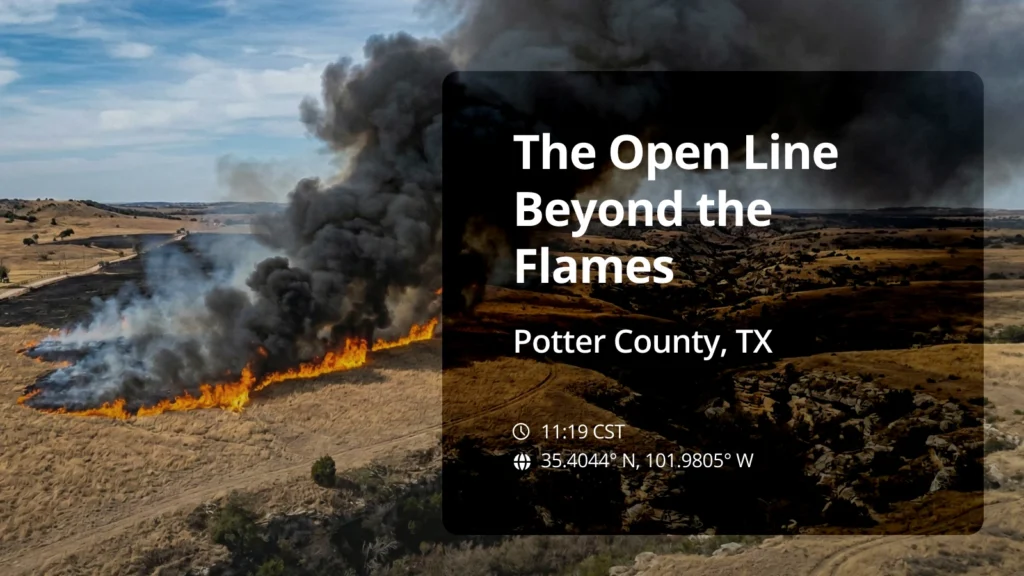

The Open Line Beyond the Flames
AXON BODY CAMERA INTEGRATION
RAPIDSOS REAL-TIME LOCATION SHARING
The call came in as a grass fire.
Rural properties. Half-acre lots. Open field dropping into a ravine. Multiple callers reporting smoke northeast of their locations. Units started toward the area.
Then another 911 line connected.
An elderly man in the field had called while trying to put the fire out himself with a garden hose — the flames already larger than he could control alone. Dispatchers gathered what they could: his general position, the direction of the fire, the fact that he was still standing and moving.
And then he stopped talking.
The line stayed open.
No response.
No sound.
In an Emergency Communications Center, silence is rarely neutral. Silence means something changed.
“We didn’t know what happened,” said Michelle Anderson, who was both supervising the floor and working the incident as calls continued to come in. “Did the fire get him? Did he collapse? Was there some kind of medical emergency? We didn’t know.”
They kept the line open and called out to him repeatedly by name. Nothing.
Somewhere in that field, a caller had gone quiet — and they needed to find him fast.
Bridging the distance
Even with responders en route, locating a single person in open terrain can take critical time. But that morning, something new had quietly appeared on their screens.
Earlier that day, the center’s Axon integration with RapidSOS had gone live, allowing dispatchers to see responding deputies’ GPS locations alongside the pinpointed location of a 911 caller.
They hadn’t even expected it yet.
“We didn’t know when it was going to start working,” Michelle said. “Was it going to be a week? A month? And then suddenly — there it was.”
One dispatcher could see the deputies moving on the map in real time. Another relayed directions over the radio.
Go a little farther north.
Shift east.
You’re almost on him.
“It was just another tool in our toolbox to help the public in one of the only ways we can — because we can’t physically be on scene with them,” Michelle said. “It makes you feel more involved, because we can see where they are and help guide them to where they need to be.”
Within minutes of arriving in the area, deputies located the man in the field.
Alive.
One dispatcher could see the deputies moving on the map in real time. Another relayed directions over the radio.
Go a little farther north.
Shift east.
You’re almost on him.
More than a fire
At first, responders believed they had simply found an exhausted property owner who had overextended himself fighting flames.
But as they assessed him, they recognized something more serious. He was in cardiac distress — later confirmed to be atrial fibrillation, a common-but serious heart arrhythmia, requiring urgent medical care.
An ambulance was called. Treatment began. A week later, the center learned just how critical the situation had been.
Minutes had mattered.
And those minutes were shortened by something dispatch rarely has enough of: the ability to see exactly where both the caller and the responders were in relation to each other.
The touchdown moment
For dispatch, there is rarely a scene to witness and almost never a patient to follow. Outcomes arrive later, secondhand, if they arrive at all.
But in that moment — when deputies confirmed they had him — the impact was immediate.
“I guess you could equate it to scoring a touchdown,” Michelle said. “There’s that elation — wow, we got him. We found him. Good job, team.”
The caller himself may never fully know how he was located so quickly across open ground. From his perspective, deputies arrived.
From dispatch’s perspective, they never left him.
The work behind the work
Stories like this rarely surface outside the ECC. The public sees responders reaching someone in need. The coordination that made it possible remains largely invisible.
“I don’t think the public really knows how integral dispatch is in these kinds of situations,” Michelle said. “They just think the deputy found them. They don’t see what’s happening behind the scenes.”
What was happening behind the scenes that day was a quiet alignment: experienced telecommunicators, new location awareness, and a team willing to use every available tool without hesitation.
“Don’t be scared of it,” Michelle said of emerging technology. “Jump in with both feet and run with it. It’s there to help you, not hurt you.”
Then and now
Michelle has worked long enough to know exactly how differently this search would have unfolded earlier in her career.
“It would’ve been: he’s in the northeast corner of the field. That’s all we have,” she said. “Now it’s almost down-to-the-inch accuracy. It’s definitely been a game changer.”
In this case, that accuracy—combined with dispatchers actively guiding responders across terrain—shortened the distance between crisis and care.
A silent line.
An unseen patient.
A field measured in acres.
And an Emergency Communications Center that never stopped searching until he was found.