
The Challenge
Every major event tests a 911 center a little differently.
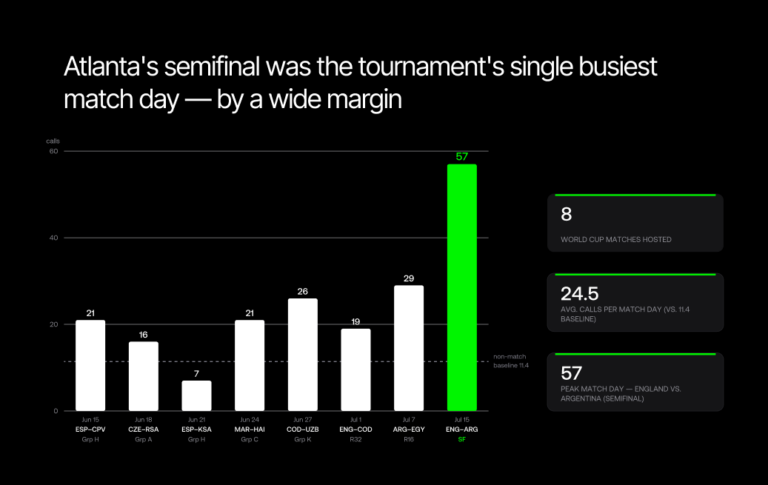
A championship game brings thousands of visitors for a weekend. A concert creates predictable surges before and after the show. But the World Cup asked Atlanta’s E911 Communications Center to operate at that level, not for a day or a weekend, but for more than five weeks.
Visitors arrived from around the world, speaking dozens of languages. Multiple public safety agencies needed to operate from the same picture. Routine calls continued alongside true emergencies. And while dispatchers answered every call, leaders across the city needed the same situational awareness without standing on the communications floor.
Atlanta had prepared for large events before.
They had never prepared for one like this.
The World Cup ran from June 11 to July 19, 2026 — a five-week window, compared to roughly 10 days of lead time for the 2019 Super Bowl. Atlanta’s E911 Communications Center has hosted major events before. “We’ve hosted many large-scale events — we did Super Bowl in 2019, football games, basketball games, baseball games, large conferences, seminars” — but, as Lisa Henley, Atlanta E911’s Deputy Director of Operations, put it, “we’ve never had one of this scale.”
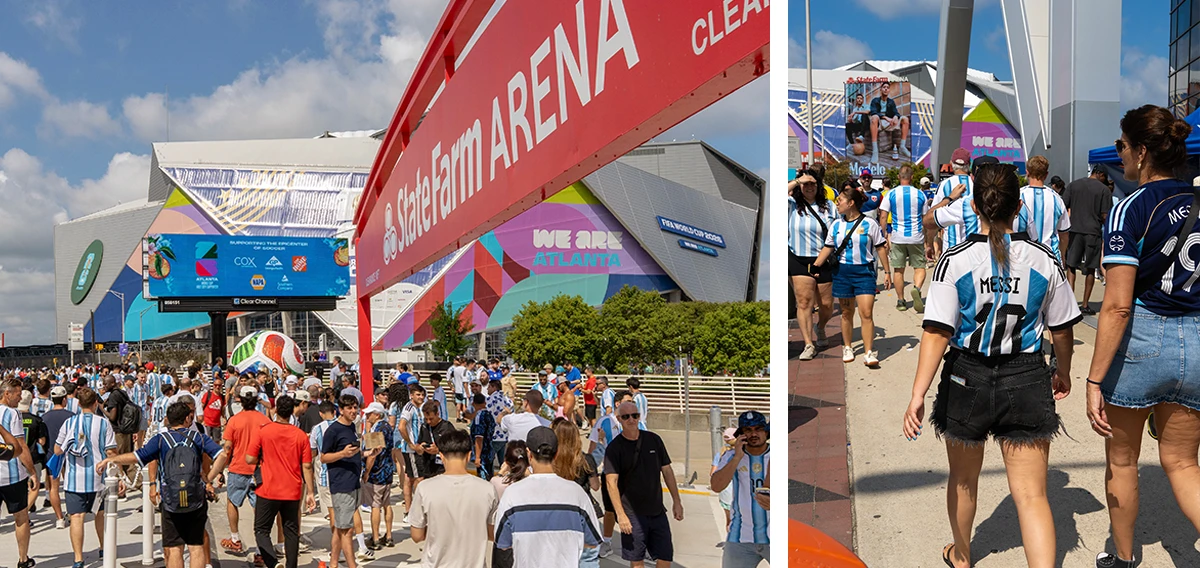
Preparation started two to three years out, with dedicated planning to understand what the event would require before fans ever arrived. As planning progressed, four things stood out as critical to getting a large-scale event like this right:
1. Multi-agency coordination. Atlanta’s 911 center doesn’t operate in isolation. During a major event, Cobb, DeKalb, the airport, and surrounding jurisdictions all need to be working from the same information in real time, without relying on phone calls that may not get through under event-level load.
2. Communicating across languages. A global event like the World Cup meant fielding calls from a far larger share of non-English-speaking callers than the center typically handles Visitors from dozens of countries, in a moment where getting accurate information quickly is critical regardless of what language a caller speaks.
3. Call volume management. Hosting a global event meant preparing for significantly higher call volumes while continuing to answer the everyday emergencies that occur in any city. Managing routine, non-emergency requests efficiently was essential to protecting dispatcher capacity for life-safety calls.
4. Command-level awareness. The center had the information as it came in. Leadership needed access to that same picture in real time, without being physically present in the room.
As Marshall Freeman, Chief Administrative Officer for Atlanta PD, put it, framing why the 911 center’s role in an event like this can’t be an afterthought: “911 is the backbone that runs public safety in any city in America. You have got to bring them into the conversation every single time. They’ve got to have a seat at the table.”
The Solution
Once preparation for the World Cup was underway, RapidSOS became central to how Atlanta’s center operated in five ways.
Multi-agency interoperability
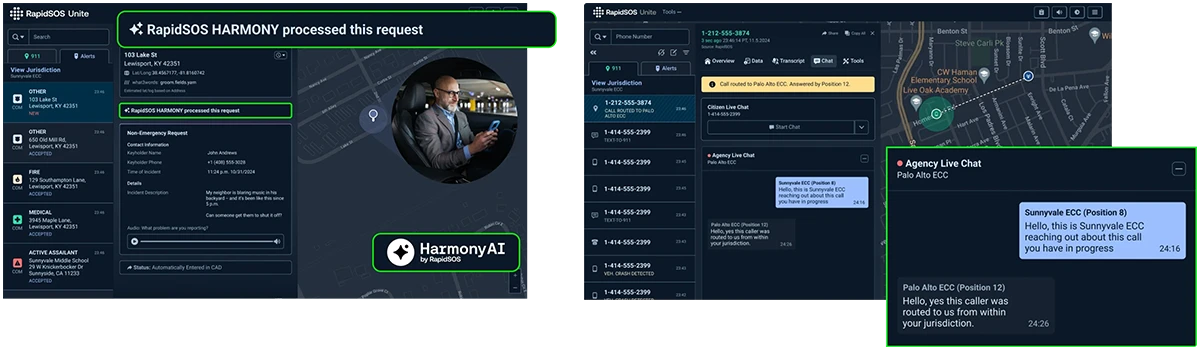
Coordinating across jurisdictions was a top priority going in, since a major event makes phone-based coordination between agencies unreliable at exactly the moment it matters most. Desirée Arnold, Atlanta’s 911 Director, explained why a shared technology layer mattered more than another line to dial: “We want to make sure that in the event of a large-scale event, if I needed help from Cobb or DeKalb or the airport, we’re all using the same technology and we’re able to communicate with each other via that technology — without picking up a phone. Because if there is a major event, it’s going to be difficult to reach each other by phone.”
Non-emergency call automation (Harmony AI)
With an estimated 20,000 non-emergency calls over the course of the event — noise complaints, abandoned vehicles, and other administrative traffic — keeping that volume from crowding out life-safety calls was essential. Dispatcher Tamiko Mapson described what that looked like on the floor during the tournament: “During high volume calls, this expedites how the call is being handled and helps with call processing times. It’s not a transfer — it’s all in one place. That makes it really easy for the dispatcher to move forward.”
Real-time translation and transcription
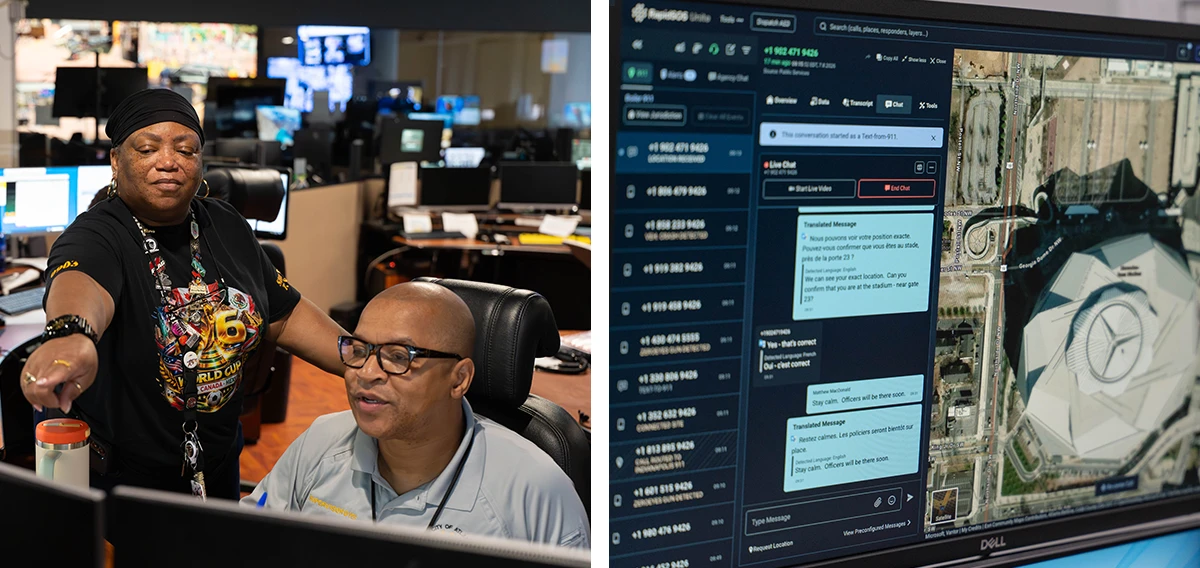
Atlanta’s center supports over 37 languages via voice translation and over 200 languages for text translation, used live on the call rather than transferring out to a third-party language line. Arnold pointed to a specific call where the capability made the difference between confusion and resolution: “We actually had a call where they were unable to understand what the caller was saying, and we were able to use the transcription to guide the caller through and to locate them.”
They actually can see the transcription, we’ve actually had a call where they were unable to understand what the caller was saying, and we were able to use the transcription to guide the caller through and to locate them.“
Precise location
Locating people quickly across a much larger and more crowded footprint than any prior event was another early priority. The system now pinpoints a caller’s location to within feet — a marked shift from what a 20-year Atlanta E911 supervisor described as historically relying on “hearsay — what they’re telling us.” Mapson added that the precision has practical value even in training: “Training new hires on using this tool, we can show them how to pinpoint where the caller is exactly — use that information to get the callers to verify that is where they are, and being able to process their calls a lot easier.”
Command-level situational awareness
Leadership needed the same real-time picture the center had, without being in the room. Freeman described how that worked day to day: “When they’re able to sit there and look at the screen, that gives them the early insights — for us that has been very important to get situational awareness also at the command level. I’m not there answering the 911 call, but what I can do is, at my office, open it up on the web browser and actually get the same information that they’re getting here in the center.” He pointed to early notification as the specific driver of that value: “Being able to get notified of things even before a CAD entry is created — that level of early insight is where we see the biggest value. And it’s exciting to think about how technology like this connects with other solutions like drone as a first responder.”
The Impact
- Coordination held up without phone dependency. Cobb, DeKalb, the airport, and Atlanta’s own center worked from a shared real-time information layer rather than relying on calls between agencies during the exact conditions — a major event — when phone coordination is hardest.
- Operator capacity protected under unprecedented load. Automating non-emergency call volume kept dispatchers focused on genuine emergencies, without needing to transfer calls out of the system to do it.
- Leadership saw the same picture as the center, in real time — extending situational awareness beyond the room where 911 calls are physically answered, with early notification “even before a CAD entry is created” cited by Freeman as the single biggest source of value.
- Language was not a bottleneck. Arnold’s example shows the capability working in an actual call, not just in theory: a caller who couldn’t be understood was still located and guided to safety via transcription.
Looking beyond the tournament itself, both Freeman and Arnold described the World Cup as a turning point in how their teams think about the technology going forward. Freeman put it in terms of what the tournament revealed: “What RapidSOS has allowed us to do is expand our way of thinking. There are features within the solution we simply had never thought about — and being educated on how other 911 centers are using them has helped us tremendously.” Arnold framed it as a standard the department now expects to hold itself to, event or no event: “If you don’t move forward, you’re going to be left behind. RapidSOS is on the cutting edge — and the standard we’re working toward is that it doesn’t matter what agency someone calls. Every citizen deserves the same level of service.”
City leaders — including Mayor Andre Dickens and APD’s police chief — have since described the World Cup at a recent press conference as a real-world stress test for the city’s 2028 Super Bowl preparation, citing lessons in crowd movement, downtown activation timing, and real-time resource shifting across agencies.
For Atlanta’s team, the tournament closed out as a clear point of pride. “Atlanta is such a marquee city. There’s no greater place to have seen all of the fans from all around the world. We have done a phenomenal job of getting through this entire World Cup. “ Freeman indicated. Director Desirée Arnold continued, I’m very proud of all the changes that we’ve made and the changes that we’re gonna make.”
Connectivity saves lives
See how RapidSOS can connect your agency or enterprise to the world’s largest Safety Network.