

If you’ve ever had to manage a 911 call that was answered out of jurisdiction—because of a surge, an outage, or another policy-routing decision—then you already know the problem:
You’re not short on talent.
You’re short on shared context.
And in that gap—between the answering ECC and the authority having jurisdiction—minutes get burned on manual relay, repeated questions, and phone-tag coordination that should never be the deciding factor in an emergency.
Real-Time Interoperability with HARMONY AI exists to close that gap.
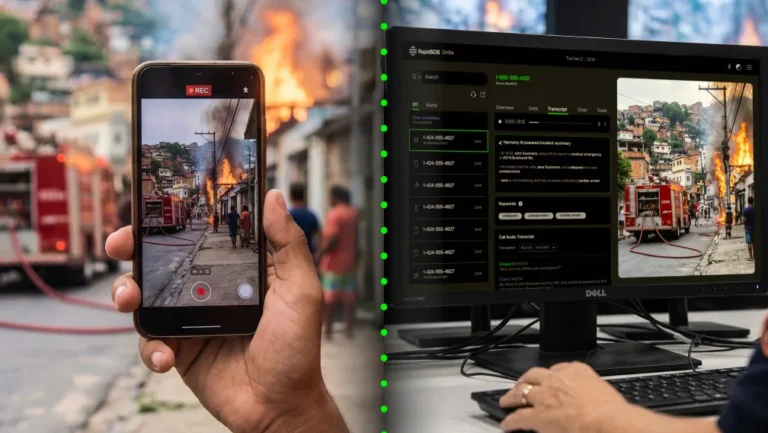
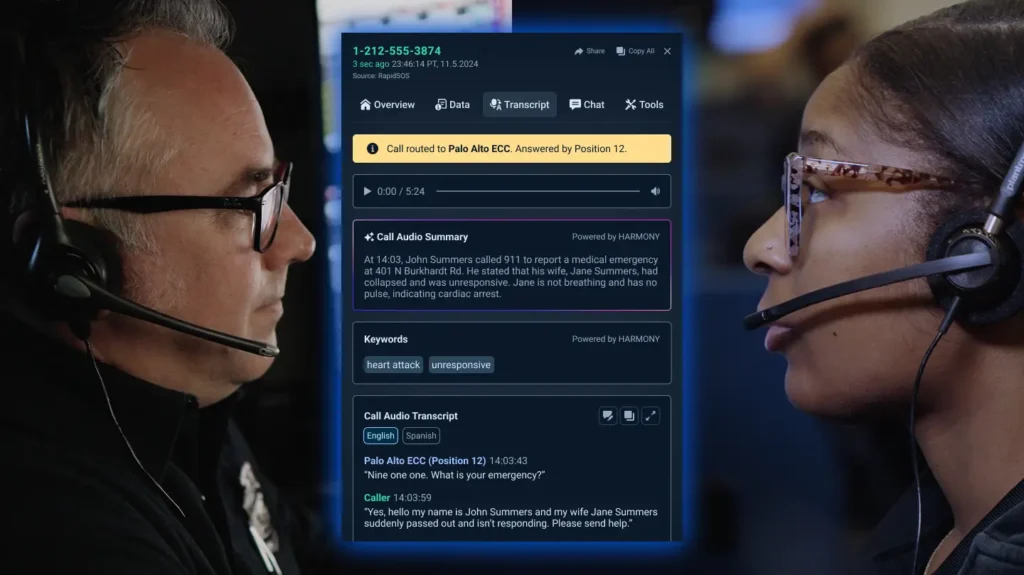
Real-Time Interoperability enables live call intelligence to flow securely between ECCs in real time so that mission-critical data, like a live call transcript and automatic call summary, is visible across jurisdictional boundaries, even when the voice doesn’t.
Real-Time Interoperability provides live visibility and coordination between the Answering ECC and the Authoritative ECC—inside the workflow your teams already use.
RapidSOS does not route the 911 call. Carriers and NGCS providers route calls based on policy routing rules.
What Real-Time Interoperability does is make sure that when policy routing happens, the RapidSOS call intelligence follows instantly, so neither side is operating in the dark.
Even if the call is answered somewhere else, the ECC with jurisdiction can see what’s happening and act—without waiting for a phone relay.
When 911 calls are treated with policy routing (because of call volume, outages, large events, or boundary dynamics), the industry’s “standard operating procedure” is painfully familiar:
- Answering ECC takes the call, confirms it’s real, starts triage
- Authoritative ECC is blind until a manual handoff happens
- Phone calls between centers begin
- Call transfers occur (sometimes more than once)
- The caller repeats themselves
- Telecommunicators repeat work
- Directors get the “why is this taking so long?” heat—while trying to keep the wheels on.
None of that is a people problem. It’s a system problem.
And it’s one public safety has been forced to work around for decades.
When a call is answered outside the caller’s normal jurisdiction (or outside the authoritative center’s normal handling path), Real-Time Interoperability securely synchronizes what matters:
1. Live Synchronized Intelligence
Both the Answering ECC and the Authoritative ECC see live call transcripts and AI-generated summaries as the call happens.
What that changes:
The Authoritative ECC can begin dispatching based on the live transcript—without waiting for a transfer or a callback.
2. Interagency Chat (built for telecommunicators, not phone-tag)
Real-Time Interoperability opens a direct digital chat between the centers so call-takers can coordinate instantly:
- “Ask if there are heart conditions.”
- “Confirm vehicle description.”
- “We received this call, and have help on the way.”
What that changes:
Coordination happens in-line with the call, without pulling someone off a console to start hunting phone numbers.

3. Instant Language Translation
When multilingual callers add pressure to an already complex interagency moment, Real-Time Interoperability’s live call transcripts provide real-time translation to keep coordination accurate and fast.

4. Zero-Latency Situational Awareness
Authoritative centers can see the incident details and context immediately, so field response can start while the Answering ECC is still on the line.
Bottom line:
The call doesn’t have to “move” for the right agency to act.
Scenario 1
When a call lands somewhere else, but your agency still needs to act.
It happens all the time.
A call comes in, but it’s answered by a different ECC due to call volume, network conditions, or routing changes.
With Real-Time Interoperability:
- Call intelligence is instantly visible to the ECC responsible for response
- Location and context are shared in real time, so dispatch can begin without delay
- The answering ECC continues to support the call—without a disruptive handoff or restart
The result: no gaps, no guessing, and no lost time while critical information catches up.
Scenario 2
Surge events (the “rolling calls” problem)
Big events don’t just increase call volume. They create operational chaos: calls are treated with policy routing as centers get flooded.
Within an hour after the 2025 Super Bowl ended, emergency call volumes reportedly spiked 1,300%, forcing many calls to be answered by neighboring ECCs.
In surge conditions, Real-Time Interoperability means:
- Your jurisdiction still sees the live transcript and summary
- Your dispatch decisions don’t wait on a phone relay
- The Answering ECC can support you without making the caller repeat everything
When seconds matter, shaving minutes off manual coordination is not a luxury—it’s the difference between arriving in time and arriving too late.
Scenario 3
Outages and continuity (when the director’s phone becomes 911)
When a center loses core infrastructure, calls may be answered elsewhere based on policy routing decisions and network conditions.
Real-Time Interoperability is built for this reality:
- Even if another ECC answers, the Authoritative ECC can still see live call context
- Interagency chat lets you coordinate response immediately
- The caller doesn’t have to care who answered—because the system is finally acting like one network
There is a practical requirement here: the Authoritative ECC needs some way to access the internet (generator + redundant connectivity, tethering/hotspot, jetpack/satellite, etc.). But that’s exactly the point—you can keep situational awareness even when traditional call-handling is degraded.
A lot of statewide and regional interoperability projects still default to one assumption:
Interoperability = CAD-to-CAD.
Those projects can be valuable—but directors know the tradeoffs:
- Expensive
- Multi-year timelines
- Fragile when codes change, systems upgrade, or infrastructure degrades
- Often dependent on the very components most likely to fail during disasters
Real-Time Interoperability is different because it’s:
- Real-time (not “after someone saves the call”)
- CAD-independent (so it functions just the same even if you upgrade or change your CAD)
- Fast to deploy (measured in weeks or months, not years)
- Low training burden (built into the workflow teams already use)
This is also where “interoperability beyond radio” becomes real.
Radio interoperability lets responders talk. Real-Time Interoperability lets ECCs and jurisdictions stay synchronized on what’s happening—while it’s happening.
Voice is necessary. Data continuity is life-saving.
If you’re responsible for statewide or regional outcomes—especially resilience, continuity, and interoperability—Real-Time Interoperability is designed for you.
Ideal use cases include:
- State 911 Boards and statewide funding authorities
- Regional 911 authorities / councils of government
- Emergency management and statewide emergency networks
- Any region planning for large-scale events (Super Bowl, World Cup, major festivals, etc.)
- Any area with known outage risk, staffing constraints, or heavy call surges
This is infrastructure-level resilience without the infrastructure cost.
Public safety has always done heroic work despite fragmented systems.
Real-Time Interoperability is the next step toward the system behaving the way the public already assumes it does:
- One emergency
- One shared operational picture
- One coordinated response—regardless of which building answered the call
When policy routing happens, your agencies stay in sync.
When calls surge, you don’t lose minutes to admin.
When infrastructure degrades, you don’t lose visibility.
And when the moment matters most, your teams can do what they do best:make decisions, dispatch help, and save lives—without fighting the system to do it.
If your state or region is funding “interoperability” and your plan is still centered primarily on radio or long-cycle integrations, it’s time to widen the definition.
Interoperability isn’t just talking to each other anymore. It’s sharing live, actionable call intelligence across agencies—instantly.
If you’re planning for surge events, resilience, or statewide continuity, Real-Time Interoperability is the easiest way to have your agencies operate with real-time alignment in their existing workflows—when it matters most.