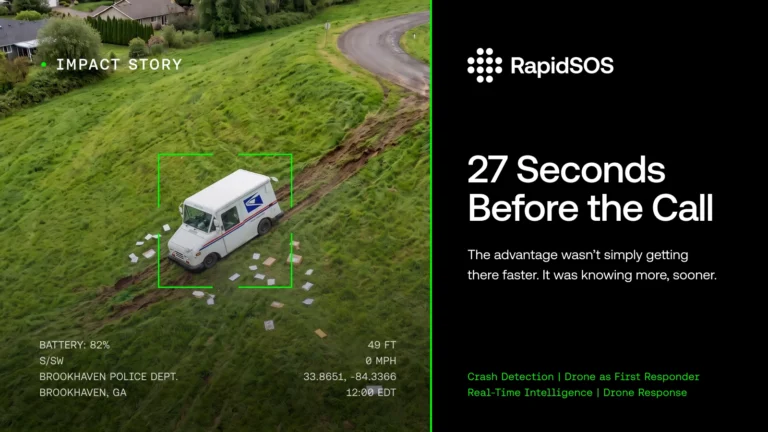


Officer Kevin Betancourt received an iPhone crash notification through RapidSOS. That was all he had at first: an alert, an accurate location, and enough information to launch. Within seconds, a drone lifted from a nearby site and began flying toward the coordinates. Twenty-seven seconds later, Betancourt had eyes on the scene.
A U.S. mail truck had rolled down an embankment, struck a storm drain, and come to rest in the brush beside a golf course. Mail was scattered across the ground. The driver was upright, moving, and reaching for her phone.
Before she could complete the first 911 call, Brookhaven Police Department already had a clearer picture of what had happened.
Betancourt could see that it was a single-vehicle crash. He could also see that the driver did not appear to need immediate medical attention. A tow truck would be necessary. Public Works would need to address the damaged storm drain. Patrol officers could begin responding with a verified location and an understanding of what they were walking into.
The response was already taking shape before the call was dispatched. For Brookhaven, that kind of head start is no longer an unusual moment. “It’s becoming so common to me that it’s my everyday,” Betancourt said. “I’ve got to remember it’s not the norm for everybody, but for us here at Brookhaven, it is.”
Closing the gap before officers arrive
Brookhaven Police Department serves a city of approximately 60,000 residents beside Atlanta, but its daytime population can grow to roughly 200,000 as people travel into the area for work, business, and daily activity. The department has grown alongside the relatively young city, expanding from roughly 45 to 50 sworn officers to nearly 100.
From the beginning, the agency leaned heavily into technology. Its operational environment now includes automated license plate readers, connected cameras, real-time information sharing, and a Drone as First Responder program designed to reach calls before officers arrive on the ground.
Brookhaven’s drone program began around 2020. In its earliest form, pilots and visual observers had to physically set up on rooftops, manage radio-frequency connections, and contend with Georgia heat, winter weather, and the limits of early equipment.
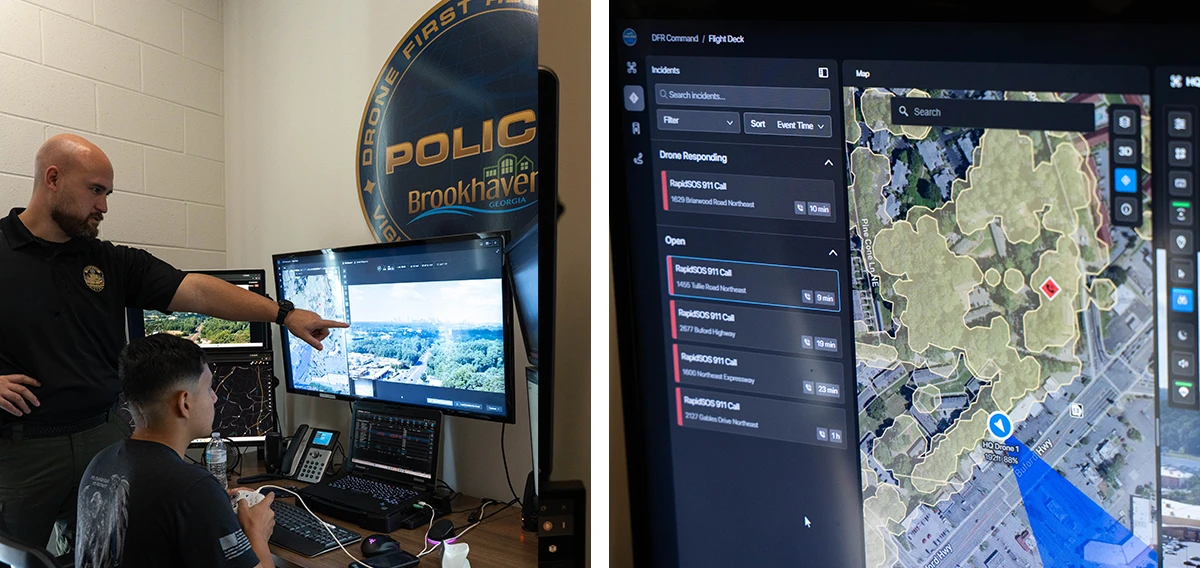
Today, the department operates four launch sites with eight drones positioned using call-for-service and officer-activity data. Two full-time pilots currently provide coverage for 12 hours a day, seven days a week. A drone can launch in approximately 10 to 20 seconds and reaches incidents in an average of about 56 seconds, according to Betancourt.
RapidSOS emergency data flows into Brookhaven’s drone platform, giving pilots the location and incident information they need to begin assessing a scene quickly.
The goal is not simply to arrive first. It is to close the information gap between the moment an emergency begins and the moment responders understand what is actually happening.
“RapidSOS shortens the time that you get that information in,” said Sergeant Samuel Jones, who oversees Brookhaven’s innovation and technology unit. “You’re able to triage information a lot quicker, assess what’s going on, and get units out to where they need to be.”
From caller perception to verified conditions
Traditional emergency response often begins with a caller describing an event from a limited vantage point. That perspective is essential, but it may also be incomplete. A caller may not know exactly where they are. They may not be able to see the full scene. Fear, distance, movement, or confusion can affect what they report. The drone adds another perspective almost immediately.
“The delay for us has just been the uncertainty,” Betancourt said. “Usually, you get the caller’s perspective. This is removing that uncertainty and giving us: this is what’s going on on scene.” That difference can change the entire response.
A report of a person with a gun may turn out to involve a uniformed security officer. A crash blocking several lanes may be documented from above so drivers can safely move their vehicles before an officer arrives. A fleeing suspect may discard a weapon in a location that is visible to someone monitoring the livestream, even if the pilot focused on tracking the person does not see it in the moment.
The drone does not replace the dispatcher, the responding officer, or the caller. It gives all of them a shared and more complete picture.
Smarter deployment, not simply faster deployment
The mail truck crash demonstrated the difference between speed alone and informed response. Brookhaven did not simply get a drone overhead in 27 seconds. The agency used that early visibility to determine what the incident actually required. A tow truck could be requested. Public Works could be notified about the exposed storm drain.
Patrol could begin moving. Fire and EMS did not need to be pulled from other calls when the driver appeared upright and uninjured. Chief Brandon Gurley sees that distinction as one of the most important benefits of the department’s approach.
“We’re able to get resources on scene quickly, deploy resources smarter, and raise the situational awareness for our officers who are going into the scene,” Gurley said.
That awareness matters because officers routinely enter rapidly evolving situations with limited information and little time to make decisions. “When we leverage technology to increase the information that’s going out to our officers, then we raise the likelihood of a more positive outcome in those dangerous situations,” he said.
For Brookhaven, the value extends beyond response time. Better information can reduce unnecessary deployments, help officers approach scenes with greater confidence, and limit risk to residents, bystanders, and responders.
When we leverage technology to increase the information that’s going out to our officers, then we raise the likelihood of a more positive outcome in those dangerous situations.”
AI puts the need-to-know information first
Brookhaven’s operating model also uses AI-generated summaries to help pilots and responders process information quickly. Instead of waiting for every update to be relayed or scrolling through layers of notes, pilots can receive a concise synopsis of the most important details as a call develops.
Jones describes that as one of the most valuable parts of the system.
“The AI synopsis is by far one of the most beneficial things that the officers get whenever they’re piloting,” he said. “You’re able to get all of that in a very short and concise summary and then assess: this is where I need to go, this is what’s going on, this is where I need to be.” That does not remove human judgment from the process.
Brookhaven’s leaders repeatedly stressed that technology must be evaluated carefully, implemented with safeguards, and supported by human oversight.
The department’s drone policy was intentionally written with strict limits. Drones are launched in response to calls for service or officer activity, not used for random surveillance of neighborhoods or private property.
The agency also considers data protection, privacy, community transparency, and operational risk before adopting new tools.
“You want to assess how it’s going to benefit the agency and weigh that against the risks it may present to the citizens and the public you’re serving,” Jones said. “Whenever you’re transparent with the community, you’re saying: this is the technology we’re using, and this is how we’re using it.”
Chief Gurley said AI became part of Brookhaven’s three-year strategic action plan as the department began exploring how it could improve efficiency while also recognizing the risks that come with any emerging technology.
The program’s success also required a cultural shift. In the early days, officers sometimes questioned why a drone was above their call. As the program matured, that reaction changed. Now officers expect the drone to be there.
They ask pilots to guide them toward suspects, monitor the broader scene, and provide the kind of perspective that a body-worn camera or ground-level officer cannot capture alone.
Betancourt described one pursuit in which Sergeant Jones was chasing a person on foot while a pilot directed him toward the suspect’s exact location.
“Having a voice in my ear telling me exactly where that person is, how far I am from them, what building they ran behind, and that they’re behind this dumpster—that was completely different,” Betancourt recalled Jones telling him.
The drone had become another form of backup.
Having a voice in my ear telling me exactly where that person is, how far I am from them, what building they ran behind, and that they’re behind this dumpster—that was completely different.”
Innovation recognized
Brookhaven Police Department’s work earned the agency RapidSOS’s inaugural Innovation in Emergency Response Award.
The recognition reflects more than the adoption of a new tool. Brookhaven has moved drones, real-time emergency intelligence, and AI-assisted response out of the pilot phase and into daily operations.
The mail truck crash is one example of what that looks like in practice.
From Brookhaven to the World Cup
During the World Cup, Brookhaven supported the City of Atlanta across several operational areas, including UAS and counter-UAS operations around stadium and fan-event locations, tactical drone support, patrol staffing, and civil-unrest preparedness.
Betancourt described the effort as a regional one, with agencies across metro Atlanta working together to meet the scale of the event. For Brookhaven, it was another example of how the experience built through its own drone program could support a much larger public safety operation.
That role reinforces the larger significance of Brookhaven’s program.
The department built its response model to serve a city of 60,000. The experience it gained is now valuable to one of the largest public safety operations the region will undertake.
The first eyes on scene
Betancourt spent years in 911 before becoming a police officer and later a drone pilot. He remembers older location technology, phase-one wireless calls, and the uncertainty that came with trying to find people using systems built for a different era.
Today, he can watch emergency data move from the caller into the dispatch center, into the drone platform, and out to responders in the field.
The ability to get a clear picture of where the caller is, get the most important information right off the bat, and deliver that information to officers and EMS—it’s all come together, I’m still in disbelief.”
For Brookhaven, the future of emergency response is not about removing people from the process.
- It is about giving them better information sooner.
- It is a drone overhead before the first officer arrives.
- An AI summary that surfaces what matters.
- A dispatcher who can send the right resources.
- An officer who knows more about the scene before stepping into it.
And sometimes, it is a 27-second head start that changes everything.
Connectivity saves lives
See how RapidSOS can connect your agency or enterprise to the world’s largest Safety Network.