

Call Pin Mapping
On Moore Reservoir in Littleton, New Hampshire, a dire scenario began to unfold in a busy recreational area: a boat was on fire. When the call came into the Grafton County communications center, the caller was offshore, miles from any visible landmark, struggling to explain his position to Communications Supervisor Michael Weden. For both the person on the boat and the team on the land, the situation was immediately desperate and difficult.
The caller was nervous, stranded 300 to 400 yards offshore with his boat smoking and taking on water while. Without immediate intervention,risked igniting fully and leaving the occupants stranded.
For a dispatcher with 19 years of experience, Michael knew the challenges of a water incident on the reservoir. Before RapidSOS, finding a boat in distress meant relying solely on a caller’s vague description — a process that was “very difficult” and often resulted in sending crews to guess which way to go from a boat launch. The location provided by the initial 911 coordinates was limited, only getting first responders into the general area. Communication Supervisor Michael Weden found it impossible to visualize the exact location.
This is where teamwork and technology kicked in. As Michael took the call, Kathleen Donovan, a 10-year veteran and training officer, immediately focused on the RapidSOS platform.
She knew that the real-time data would be the only way to quickly narrow down the location on the water.
Using the call pin in RapidSOS, Kathleen was able to dial in on the exact location of the person on the boat. Despite the difficulty the caller had describing his location, the data showed exactly where he was on the reservoir. This intelligence was immediately shared with Michael. While the fire department had already been dispatched, their travel time allowed the team to refine the response in real time.
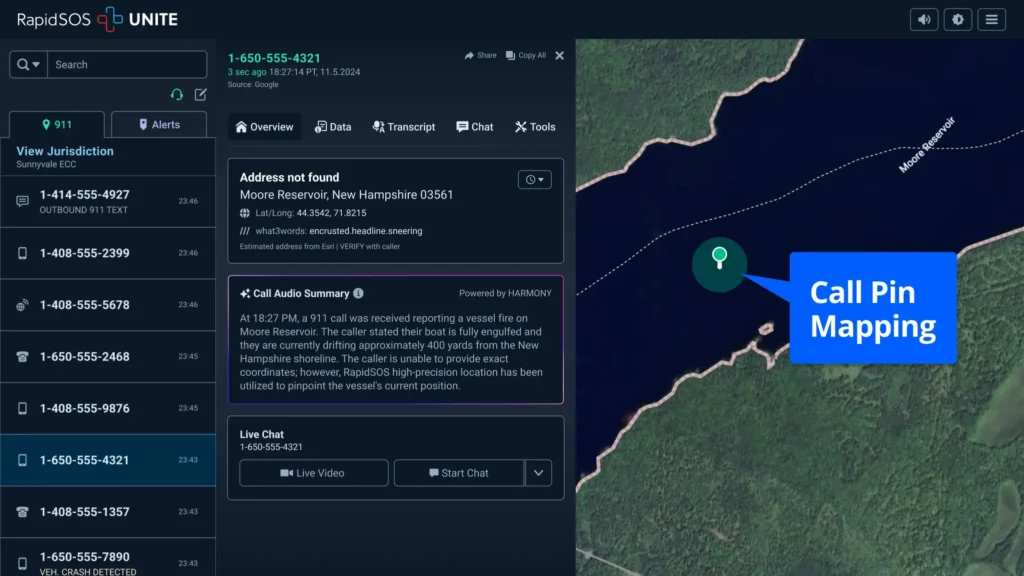
Using RapidSOS, they identified the two launches that would provide the quickest route and best line-of-sight to the distressed boat.
Because the dispatchers were able to utilize RapidSOS, the crew got there relatively quickly. In a situation where the boat was actively catching fire, this speed was the difference between a successful rescue with no injuries sustained and being stranded on open water. And because the firefighters were able to quickly stabilize and remove the boat from the water, the environmental risk of leaking fuel was avoided.
The experience of saving these boaters on the Moore Reservoir is far from a unique story in Grafton County. Michael and Kathleen’s team use RapidSOS constantly, leveraging its data for everything from guiding hikers and snowmobilers in the middle of nowhere to watching automated crash detection signals on ski slopes. They even routinely use the ability to manually enter a phone number to get location data for 911 transfer calls from Vermont.
For Michael, RapidSOS is an indispensable tool: “It helps me locate people faster than I would have been able to previously without using it”. Kathleen echoes the sentiment:
The technology removes the guesswork, helping to ensure that human instinct and persistence results in successful life saves.