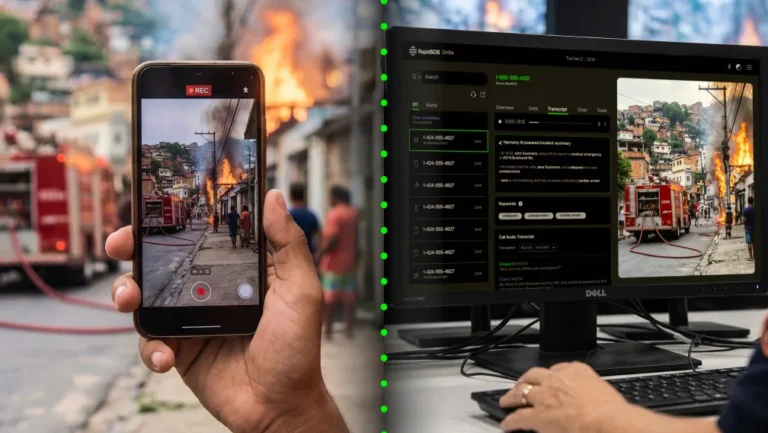


In a school emergency, the first step should be to call 911. But what if that’s not an option?
It’s why states increasingly require instructors and other staff to use wearable or application-based silent panic alarms that can instantly notify Emergency Communications Centers (ECC) for help.
However, there is a broad misconception within schools that simply pressing a silent panic alarm will automatically provide telecommunicators and public safety field responders with the exact information they need to assist. This creates safety gaps that put first responders, students, and staff at greater risk.
ECCs and educational institutions must align before deploying the technology. Too often, working together on these steps are often overlooked, resulting in miscommunication, misaligned expectations, inaccurate resource allocation, false alerts, and other adverse outcomes.
This report aims to highlight the safety gaps causing these issues and identify ways local school districts can collaborate with local ECCs to address them.
What is Alyssa’s Law?
In 2018, Alyssa Alhadeff was killed during the Marjory Stoneman Douglas High School shooting along with 16 other victims. In memory of her life, and in response to the growing number of school shootings, states across the country are passing “Alyssa’s Law,” which mandates that schools outfit their staff or institutions with silent alarms, and connect the devices to local 911 centers to reduce emergency response times.
To-date, eight states have enacted a version of “Alyssa’s Law,” and several more are considering it. Meanwhile, states like Ohio are now weighing additional legislation to add more funding to help implement the measure. The law promises to improve school safety at a time when violence is at an all-time high. But a change of this caliber doesn’t happen overnight – or on its own.
It will take close coordination between educational leaders, public health officials and technology providers to not just deploy the new devices, but to make sure the resulting workflows are established so that, when tragedy happens, 911 can more quickly get the right resources, to the right place, as fast as possible.

The above chart shows states that have passed versions of Alyssa’s Law, as well as states where related legislation is in progress. (Source: Make Our Schools Safe)
The Pain Points of Adoption
There are many situations where phones are unavailable in an emergency. There could be limited network coverage, cell phone bans in classrooms, or clear communication could be difficult or unsafe, like during an active shooter event.
That’s why silent, application—based and wearable panic buttons are becoming more popular. Each option has its own pros and cons. But regardless of the type of alarm a school chooses, school leaders must work with 911 and public safety response agencies in advance to establish clear and actionable protocols for when they are activated.
Too often, schools buy and deploy silent alarms without talking to local ECCs. This results in several safety gaps that undermine the benefit of the technology, including:
- Unclear workflows: When alarms are activated without coordination between schools and 911 in advance, there is confusion about the next steps. Where is the information received? Does it integrate with an existing system or is it a standalone solution? If the back-end systems aren’t connected, ECCs may not even get the notification. And if they do, it may not include the critical information necessary to send the most appropriate help. Is it an active assailant or a medical emergency, for example? Or, where is the emergency unfolding at the school?
- False alarms: Without a mechanism to quickly flag or recognize false activations, 911 could send valuable resources when there isn’t an emergency. Sending resources to an emergency situation that turns out to be a false alarm can also create unnecessary community concern and may cause roadway safety issues, increasing the potential for actual emergencies to arise.
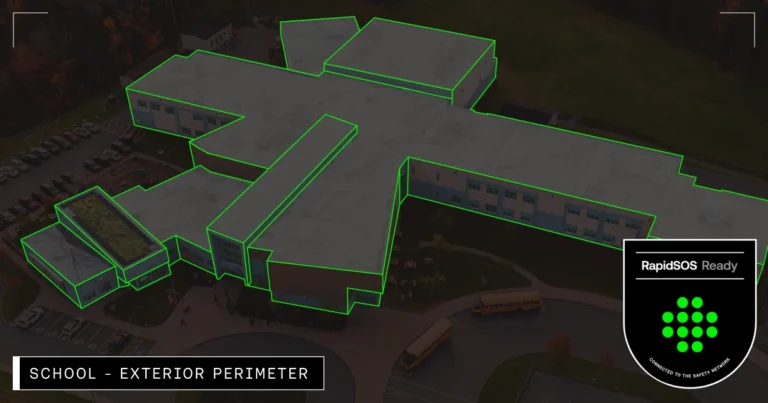
- Information gaps: Key intelligence, like school maps, are often unavailable to 911, or if available, outdated and in a folder or PDF format somewhere that has to be located. This can make it hard for first responders to know the exact location of the incident. In the case of an active assailant, first responders might lack the critical location data they need to avoid responding strategically or charging head-first into harm’s way.
- Identifying Information: In an ideal situation, a phone call with 911 is best to get critical contact information and location details. However, in a school emergency that may put staff or students in an unsafe situation. Without identifying information like teacher names and room numbers with an activation, getting field responders to the right location can be delayed.
- Communication silos: During critical incidents, communication gaps often occur due to disparate and legacy communication methods.
What’s the solution?
Before schools research and procure silent alarm technology, they should bring 911 to the table to work together to:
- Collaborate to identify technology options: Instead of immediately rushing to work with a new, third-party vendor, schools should coordinate with ECCs in advance to learn if there is a pre-existing solution to consider. Bundling services with other school districts in this way can often reduce costs and simplify the number of tools that 911 telecommunicators need to manage.
- Establish dedicated workflows: On an application, there can be separate buttons for police emergencies, active assailants, fires, and emergency medical services. It is critical to establish workflows, clear communication, and response protocols that ensure 911, field responders, and the school all are working together.
- Infuse location-sharing capabilities into alerts: 911 should instantly know the precise coordinates of any emergency. That way, first responders can quickly strategize how to get on the scene safely.
- Eliminate safety intelligence gaps: Schools and 911 should create clear information-sharing protocols to ensure that ECCs always have the most up-to-date data about facilities, staff, and students.
- Eliminate uncertainty: Enable access for every staff member. If it’s a digital panic button, school administrators, managers, and other leaders must ensure that their teams download the application, whether on their personal devices or computers, and know how to use it. If it’s a wearable alarm, users should know the correct activation method to indicate specific emergencies. And regardless of which device they choose, all school leaders should know what happens once the alarm is activated.
- Bring 911 to the Table(top): ECC representatives should always be present when schools run through potential disaster scenarios and other tabletop exercises.
- Identify point people: With the right digital connections, panic buttons can send the initiator’s and admin’s contact details directly to the emergency center. Then, 911 has a direct point of contact to follow up with, ensuring a more seamless response and helping to eliminate false alerts. But schools must establish these ahead of time.
- Improved Communication pathways: School safety technologies offer multiple pathways for communication with staff members, administrators, field responders, and 911. Allowing for more seamless coordination and flow of information.
Key Decision: Wearable or Application-Based or both?
The decision to go with an application-based or wearable silent alarm will ultimately frame how the institutions must work with local 911 centers to adopt effective new silent alarm systems and workflows:

Pinpointing the Safety Gaps

An instructor activates their silent alarm. If the teacher doesn’t follow the proper protocols or establish the right connections ahead of time, the alert may never reach 911. If it does, the telecommunicator may not have the information they need to properly send help to the correct location as fast as possible.
Action Item: Schools must work with local ECCs to establish the workflows that will activate once an alarm is pushed, whether it’s standalone buttons on an application for different emergencies or a pre-established sequence of presses on a wearable device.
911 reviews the information: Assuming the alert reaches 911, telecommunicators could still be left in the dark about the type of emergency, who is requesting help, and their exact location.
Action Item: Schools and ECCs should only consider technology solutions that include critical information provided with the alarm notification that can improve first responder situational awareness and response. This could include the person initiating the alert, their location or room number, the type of incident, administrative contact information, and any other pertinent information that can be transmitted through the device.
Help is dispatched: As professionals gear up to leave, they may find that no map of the school is available. Or, while the school may have cameras, they’re not connected to 911. Now, first responders are forced to enter a potentially dangerous situation without knowledge about the layout or the exact location where the emergency is unfolding.
Action Item: Closing these intelligence gaps ahead of time is key. Schools should supply ECCs with digital and paper copies of the institution’s maps, ensuring they are updated regularly. Schools should also seek ways to connect 911 to on-site technology, like cameras, to access feeds in an emergency.
Field responders arrive at the scene: Without the ability to contact the designated point person on-site, responders arrive to help, even though 911 has had no prior communication with school leaders. Instead of strategically responding from the safest direction or the best location, they may arrive at the wrong end of the building; they’re forced to assess the situation at the scene, delaying critical help.
Action Item: Eliminating these delays can save lives in an emergency. Every second public safety professionals spend trying to understand the situation and develop a plan is time for the emergency to worsen. However, when 911 has all the information at its fingertips, field responders are better prepared upon arrival.
The Real-World Problem With Safety Gaps
Often, when schools consider investing in silent alarms, they engage insurance companies, local police departments, and other external stakeholders. But there’s one critical partner many schools don’t coordinate with: 911 centers.
The following is an anonymized, real-world example of what happens when schools deploy new silent panic systems without working with ECCs in advance;
- At a 911 center on the East Coast, the police chief bangs on the door of the ECC director, demanding to know why officers weren’t dispatched to help with a call from a local school.
- Unaware of any emergency call, the ECC director and police chief went to ask the telecommunicators, who also did not know of any such 911 call.
- Eventually, they found out that the institution’s insurance company had offered to pay for new alert software, which the school adopted without connecting to the ECC. In fact, no one in the 911 center was aware that the school was using this application.
- After further conversations with district leaders, the ECC director found out that every telecommunicator and law enforcement professional also had to download the app on their personal phone to receive alerts from this software—a step the ECC director wasn’t willing to take.
- Working with the software vendor, the school and ECC transitioned to a desktop version of the application. Now, alerts reach 911 telecommunications instantly.
- But it was another tool that public safety professionals had to log into, train on, and navigate during an emergency. Instead, if the school had coordinated in advance, the ECC could have helped the institution adopt a silent alarm system that integrated with existing technology suppliers. The tighter integration would have reduced the burden on 911 telecommunicators and helped make workflows even more seamless, increasing the likelihood of a timely and efficient response.
Situations like this happen constantly in cities and towns across the U.S. There are counties with high populations that have only two ECCS covering over 60 police and fire departments, as well as 40 school districts with over 250 public school buildings. Another county has three ECCs for over 170 public schools.
If each institution pursues a different silent alarm system, it creates an untenable situation for already overburdened telecommunications. That’s why schools and ECCs must work together to plug any gaps that could hinder the free flow of safety intelligence and delay emergency response times.
To learn more about how RapidSOS can help, check out our school safety solutions.