

A driver is stranded with a flat tire. Someone has locked their keys inside a vehicle. Another caller has broken down and doesn’t know whom to contact.
These situations may not require police, fire or EMS, but the people calling still need help. For 911 centers, the next step has traditionally depended on local policy and available resources. A dispatcher might provide a list of towing companies, search for a provider, or send a police officer to assist.
At Houston County 911 in Georgia, River County 911 in Kentucky, and the Martin County Sheriff’s Office in Florida, telecommunicators are using another option: Roadside Assistance in RapidSOS Unite, powered by Drivers Premier.
The feature allows dispatchers to connect callers with a roadside assistance service so they can arrange help directly, while the ECC remains available for calls requiring an emergency response.
The challenge: A caller needs help, but not an emergency response
For Houston County 911 Assistant Director Veronica Edens, roadside assistance calls once presented a difficult choice. Her center had dispatched deputies for vehicle lockouts, even when those deputies were needed for higher-priority calls.
The frustrating part back then was that we had deputies unlocking vehicles when they really needed to be on higher priority calls.”
When the center stopped that practice during the pandemic, dispatchers had fewer ways to help. They could not recommend a particular company, so callers had to select and contact a provider themselves.
River County 911 faced a similar limitation in rural western Kentucky. Director Larry Fraser explains that the center typically gave callers the numbers of its two local wrecker services rather than choosing a company for them.
At Martin County, dispatcher Angela Chapman describes a familiar alternative: sending a deputy and requesting a wrecker through the agency’s established rotation. A driver who did not know which company to call could leave the dispatcher searching for another option.
These approaches reflect different local practices, but the challenge is shared. A telecommunicator has identified a non-emergency need and wants to help the caller reach an appropriate service without unnecessarily committing emergency resources or taking responsibility for selecting a private provider.
A new connection between 911 and roadside assistance
Through the RapidSOS–Drivers Premier partnership, eligible roadside assistance calls can take a different path.
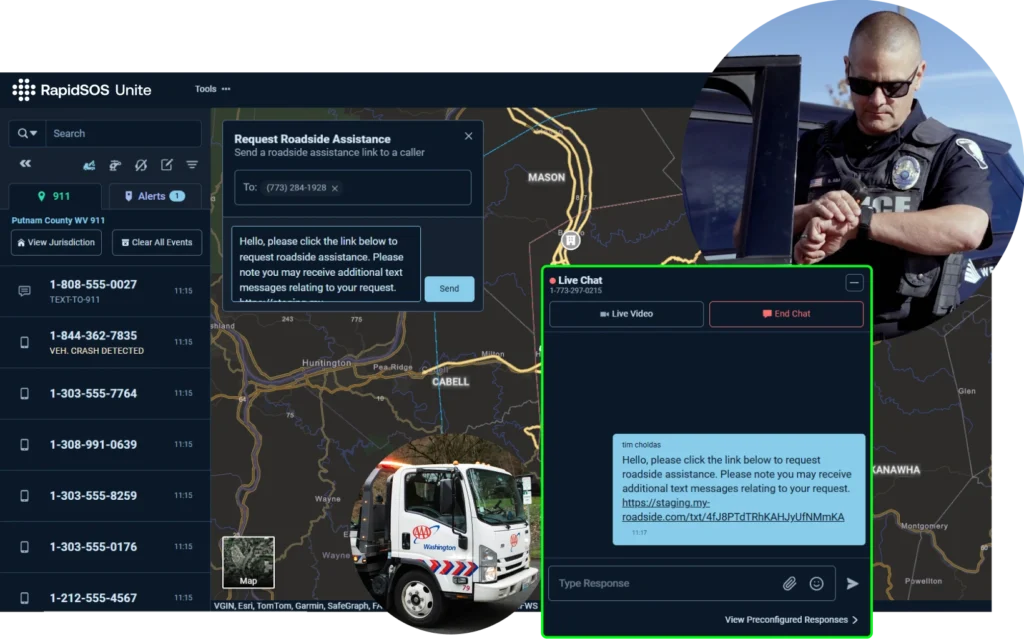
A telecommunicator can send the caller a link through RapidSOS Unite. The caller uses it to provide their location, describe the vehicle problem, review the applicable service price, and request assistance. Once the request is submitted, they can follow its status directly on their phone.
The dispatcher makes the connection. The caller takes the next steps with the roadside assistance service.
For Houston County, the feature gave dispatchers an alternative to either sending a deputy for a non-emergency lockout or telling a caller to find help independently.
Instead of saying ‘I can’t help you,’ it does the work for you.”
The same capability proved useful in a place where its director had not expected it to be.
River County: A dispatcher discovers another way to help
At River County 911, Fraser had not formally introduced the roadside assistance feature to his dispatchers. He initially thought it was more suited to larger cities than to his rural Kentucky community.
One of his part-time dispatchers saw the Motorist Assist option in RapidSOS and decided to try it when a caller needed help that did not fit the center’s emergency response resources.
She connected the caller with roadside assistance. According to Fraser, a service provider was arranged within minutes, the caller’s vehicle was repaired, and they got back on the road.
She saw the button and she tried it.”
The significance was not simply that the dispatcher found a new feature. She recognized what the caller needed, assessed that the situation did not call for the center’s emergency resources, and used an available option to help.
Fraser later summed up what the capability meant for his center:
It gives us an option.”
Martin County: Another option without replacing the wrecker rotation
At the Martin County Sheriff’s Office, roadside assistance has become a regularly used option, according to dispatcher Angela Chapman.
Chapman says the center still follows its established wrecker rotation for police initiated requests. Roadside Assistance gives dispatchers another way to help with appropriate disabled-vehicle calls without replacing that process.
So I like the feature of this because we can connect them to anybody and still have our rotation, you know, kept for those arrests, the crashes.”
The feature was introduced through an email from the center’s 911 manager/coordinator, a PowerPoint walkthrough, and printed instructions at each console. Chapman says those reference materials were especially useful on night shift, when administrative staff were not available to answer questions.
The adjustment was straightforward, although dispatchers sometimes needed a reminder that the option was available.
It’s just feedback I’ve heard is, this is simple. It’s just simple.”
For callers who do not know which provider to contact, Chapman says being offered a connection to roadside assistance has generally been welcome.
Built around a need identified by 911
The idea behind the partnership grew from conversations with telecommunicators.
During discussions about how Drivers Premier Powered by Agero could better support 911, a telecommunicator raised a question: why wasn’t the company asking about roadside assistance calls?
Agero explored that need further with ECCs and heard that centers were regularly receiving requests from people who needed vehicle help but did not necessarily require an emergency response.
Drivers Premier brings Agero’s roadside assistance process into a workflow telecommunicators already use. The caller can arrange service and receive updates directly, while the ECC can move on to its next responsibility.
The result: Help that fits the call
These three centers demonstrate different uses of the same capability.
At Houston County, Roadside Assistance provides an alternative to sending deputies on non-emergency vehicle calls or leaving callers to find a provider themselves. At River County, a dispatcher used it to help a stranded caller get back on the road. At Martin County, the feature offers another path for disabled-vehicle calls while the agency retains its wrecker rotation for arrests and crashes.
The common thread is the telecommunicator’s judgment. Dispatchers still assess the caller’s circumstances and determine whether an emergency response is needed. When roadside assistance is appropriate, they have a way to connect the caller with help without managing the entire service request.
For a person stranded with a vehicle problem, that connection matters. For the 911 center, it means another way to help while remaining ready for the next emergency.