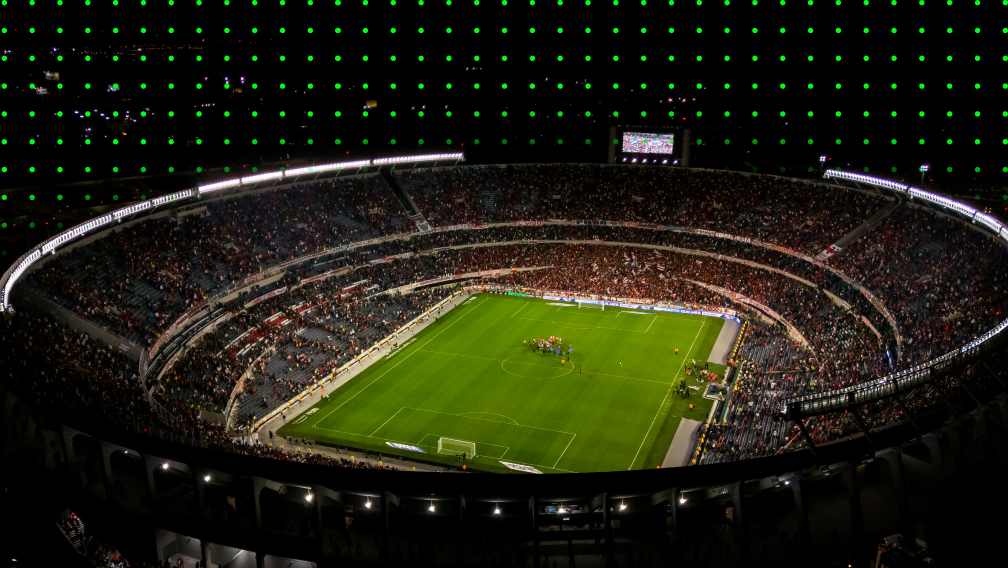

“Seventy-eight Super Bowls in 38 days. That’s what we executed on,” said FBI Director Kash Patel of the 2026 World Cup. “We’re proud to report that, thank God, and thankfully to the men and women of the FBI and our partners, we had no significant criminal attacks during this World Cup.”
The scale was extraordinary: 11 U.S. communities. 78 matches. 38 days. 6.5 million international visitors. Across those venues, 911 call centers experienced 2,878 emergency calls, and as much as 3.4× surge on match days.
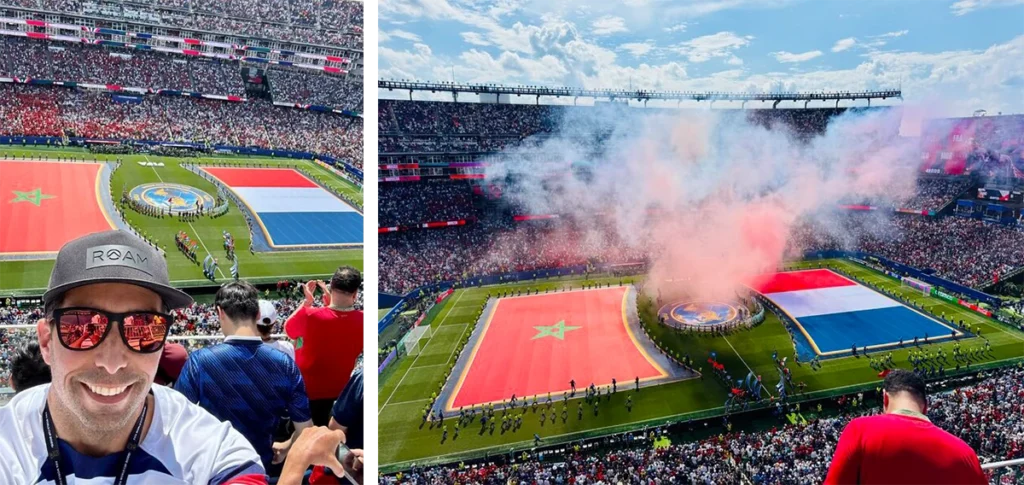
At MetLife Stadium alone, match days averaged 10x more calls than on non-match days. I went to a game at Gillette Stadium in Boston, where call volume hit 15 times normal activity. During peak hours, call volume hit 10 times normal activity. The data was clear: scale creates complexity.
Yet here’s what’s worth celebrating: while much of the discussion was about what happened on the field, what actually matters is what didn’t happen off it. There wasn’t a single mass casualty incident. There were no system failures. No communication breakdowns. No chaos. This wasn’t luck.
Why This Works: Three Critical Success Factors
The reason we can consider the World Cup the safest large-scale events in recent history was a combination of structural and operational strengths working together. And most importantly, our public safety heroes on the ground.
- Large-Scale Coordination Across Government Levels
From local agencies and municipalities all the way through regional, state, and federal levels, coordination was seamless. But it wasn’t just government. Private security teams at stadiums, businesses across the community, and non-governmental organizations worked as one unified operation. When MetLife Stadium in New York was hosting a match, it wasn’t just that one venue’s responsibility—the entire surrounding region understood it was part of a coordinated whole. This multi-level coordination, spanning both public and private sectors, meant that resources flowed where they were needed, and decision-making happened at the right speed across jurisdictional lines.
- Interoperability Across Agencies
A call came in, but which jurisdiction did it fall into? Could they coordinate? Could they share information and get help in time? This is not something to take for granted. During the World Cup, agencies that historically operated in silos were able to move information across jurisdictional boundaries in real time. If a 911 call came in that straddled two agency territories, responders knew instantly—no delays, no confusion about who owned the problem. They could support one another without bureaucratic friction. This interoperability is what allowed a surge at one venue to be absorbed by the entire region’s capacity, not just that individual location’s resources.
- Innovation and Technology Deployed by Skilled Teams
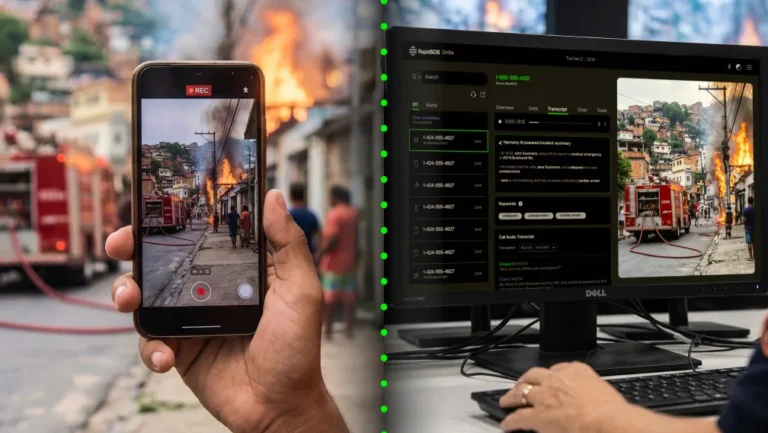
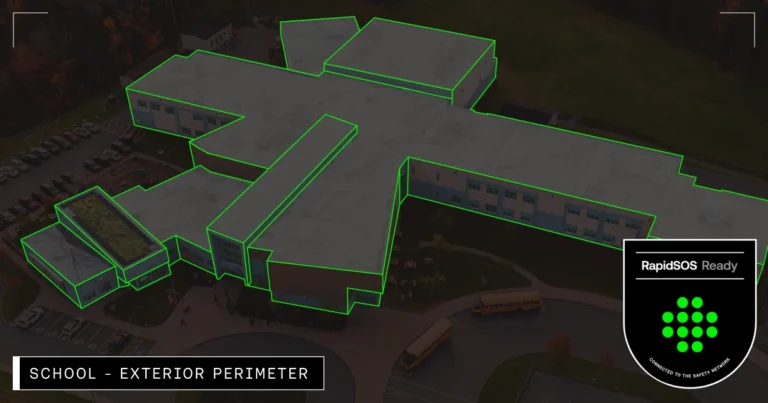
Technology alone doesn’t win the day. What worked was the combination of highly skilled, highly trained public safety leaders and private security teams using incredible technologies that simply did not exist at the last major large-scale sporting event hosted in the U.S. These were things like AI-powered language translation—allowing people who didn’t speak English to describe emergencies clearly to English-speaking 911 dispatchers in real time. Counter-drone operations were entirely new. For the first time, agencies were equipped not just to identify drones in their airspace, but to take down bad-actor drones before they posed a threat. Precision location technologies. Real-time video feeds from venues. These capabilities, in the hands of the right teams, created a level of situational awareness that was unprecedented.
The Data: What We Learned
The World Cup data reveals critical operational patterns. Match days averaged 3X calls per venue daily, compared to non-match days—a swing that demands predictive infrastructure. Some venues showed even steeper curves: at MetLife Stadium, eight match days averaged 10X the number of calls daily versus non-match days. During the Final, the peak hour ran 200% above typical activity.
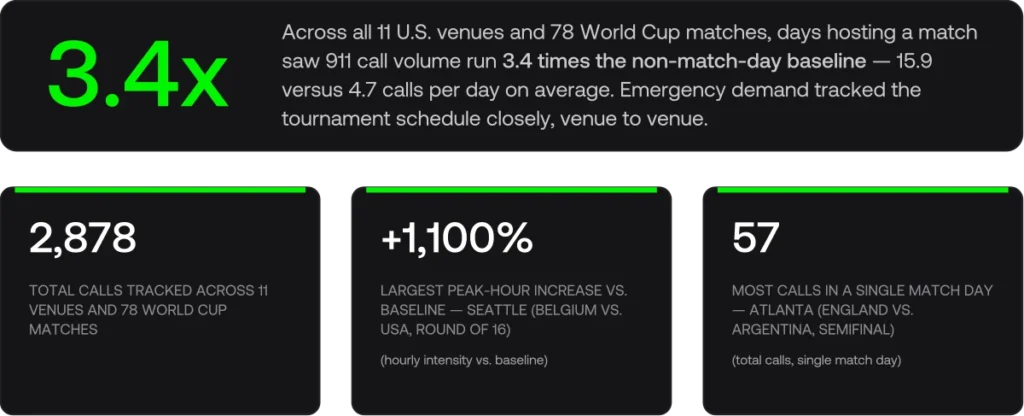 > 2026 World Cup: 911 Call Activity Across U.S. Venues (Data Lab)
But here’s what matters about these numbers: they represent real decisions made by dispatchers working with better information. When MetLife Stadium peaked, dispatchers didn’t just react. They anticipated. They routed. They coordinated across the five boroughs knowing exactly where resources were needed before the next surge hit. That 93% spike in calls—858 calls in 30 minutes across New York—didn’t create cascading failures. Why? Because the people managing the system had real-time data, unified location information, and the tools to translate an international caller’s emergency into actionable intelligence in seconds.
The busiest match day was the England–Argentina semifinal at Mercedes-Benz Stadium, which had a peak hour running 1,000% above typical activity. Yet dispatchers made the right calls. First responders got to the right places. Interestingly, the data revealed that venue and local market dynamics, not team matchups or final scores, drove call volume. This insight is crucial for large-scale event planning: any given ECC and venue will have its own surge signature—and public safety leaders need systems flexible enough to learn and adapt in real time.
Consider New York alone. During the World Cup Final at MetLife Stadium, the five boroughs handled 33,704 calls from 24,480 unique callers across the tournament window. Manhattan peaked at 185 calls in 30 minutes, 116% above normal. Without real-time call routing, AI language translation for international callers, and unified location data across all five boroughs, that surge would have created cascading failures. Instead, dispatchers knew exactly where to allocate resources before demand materialized.
What the World Cup Proved About People and Systems
The World Cup was a human success story enabled by better systems. Thousands of dispatchers, law enforcement officers, firefighters, and security professionals made split-second decisions that saved lives. They coordinated across lines that historically divided them. They trusted systems and each other. And they delivered—not because of the technology, but because they were the right people, trained, prepared, and connected to the intelligence they needed to make the right decisions.
That’s what we should honor. Not the infrastructure. Not the innovation. The people who built it, learned it, and executed it under pressure. When you strip away all the data and all the technology, what made the World Cup safe was a commitment by public safety leaders, private security teams, and technologists to say: we will not let scale overwhelm us because we will be smarter about it.
This matters deeply when I think about other large-scale events – Coachella, the Super Bowl, March Madness, SXSW, to name a few. As scale increases and complexity compounds, the margin for error with generic AI shrinks to zero. Purpose-built systems designed for mission-critical public safety are the only answer.