Background
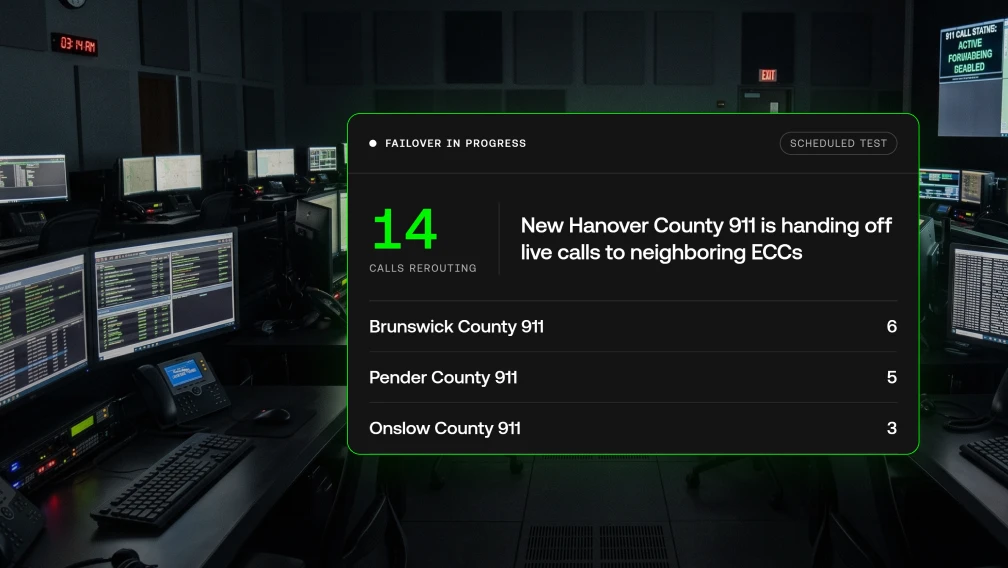
New Hanover County 911 is a coastal county communications center that has been an early participant in North Carolina’s statewide move toward agency-to-agency collaboration through RapidSOS. As Lauren Young, a supervisor with five years in that role and 15 years of experience in 911, explains, not every agency in the state is on the platform yet, but New Hanover County has been running tests with surrounding counties to validate how well the tool performs under real operational conditions — including worst-case scenarios.
The Challenge
Every 911 center has a contingency plan for the day its own operations go down — a full “abandonment” scenario, where all incoming calls have to be handed off to another county’s center. Historically, this kind of handoff has a built-in lag, requiring additional steps to share call information between centers. This included remotely accessing another center’s CAD system and manually entering the information into our own, or using other communication methods to relay critical details. These extra steps delay dispatching emergency responders when every second counts.
New Hanover County wanted to know: if we had to abandon our center today and hand our calls to a neighboring county, how much faster could that handoff be with Collaborator in place?
The Test
New Hanover County ran a planned contingency drill simulating a full center abandonment. As part of the drill, the center notified its predetermined failover agency — per its contingency plan — and switched its incoming calls over to that neighboring county’s communications center for handling.
With RapidSOS Collaborator active, the receiving county’s telecommunicators could see a live transcription of the call as it was happening — in real time, while New Hanover’s original call was still being processed on the other end.
In Lauren’s words:
With Rapid SOS Collaborator we were able to see the transcription as they were getting the calls, and so there was no delay in dispatch waiting for CAD to CAD, waiting for that code to be put in and sent over. I already had an address and the nature of the call while they were processing — with live updates. So we could immediately go ahead and get assistance on the way.”
The Result
Instead of having to remotely access another center’s CAD system to view call information and then manually enter it into their own system, the receiving center had that information immediately, live, as the conversation was unfolding. That meant assistance could be dispatched right away rather than after the usual transfer lag — turning what is normally a multi-step, systems-dependent handoff into something closer to real time.
For a coastal county whose contingency plans exist precisely for the moments when its own center can’t take calls, that speed matters: a successful abandonment plan is only as good as how fast the backup center can act on what it’s given.
Why It Matters
This test is one piece of North Carolina’s broader statewide rollout of RapidSOS Collaborator — New Hanover County has conducted multiple tests with other counties across the state, working toward a future where any agency in the state can hand off calls to another with full context, not just a bare transfer of the line. As more North Carolina agencies join the network, this level of contingency readiness becomes part of the connection itself, giving neighboring ECCs the ability to share critical call information in real time, whenever and wherever it’s needed.